How much does a restaurant website cost?
The real price ranges for a restaurant website, from the digital menu to table reservations. And errors that cost more than the site itself.
 Written byAlexander D'Auria
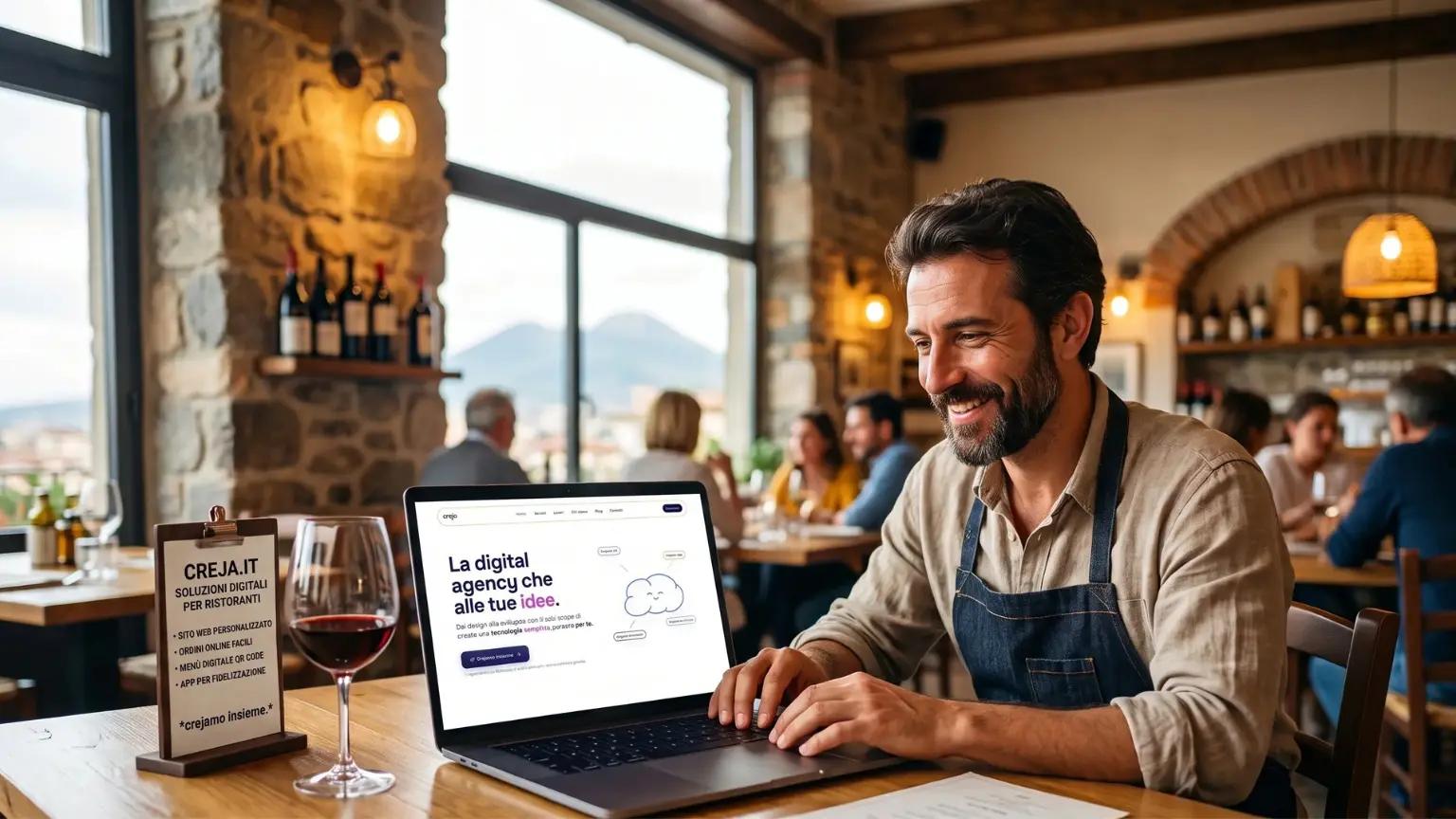
«And how much does the site cost me?» Every restaurateur asks us this, usually towards the end of the first chat. The honest answer is that it depends on what that site needs to do. A display case with the menu is one thing. A site that takes reservations on its own and speaks English to tourists is another. Here you will find the actual price ranges we give to our customers, and at the bottom the errors we see most often.
A premise. For a restaurant the site works in tandem with the Google tab, the one with reviews, photos and opening hours. That's where customers find you. On the site, they decide.
The price ranges
The display case with menu starts from around 950 euros plus VAT. A few pages done well: the always updatable menu (not a PDF), the photos, the timetables, the map and the buttons to call or write on WhatsApp. For most restaurants this is the right starting point.
The site with table reservations is in the medium range. Online booking is added to the window, with automatic confirmations and reminders. In practice: fewer phone calls during service and fewer empty tables due to no-shows.
Multilingualism is useful for those who work with tourists, and from Pompeii to Sorrento it applies to almost everyone. A foreign guest chooses the place he can read. The cost depends on how many languages are needed and how much content there is to translate.
Delivery and online sales are the high end. Orders, payments, perhaps the sale of wines or specialties throughout Italy. Here we enter the territory of e-commerce and the price is built on the project.
The four bands compared
| Showcase with menu | With reservations | Multilingual | Delivery and shop | |
|---|---|---|---|---|
| Indicative price | from €950 + VAT | mid range | It depends on the languages | on project |
| Updatable digital menu | ||||
| Online table reservation | ||||
| Languages for tourists | if needed | |||
| Online orders and payments | ||||
| Indicative times | 3-5 weeks | 4-6 weeks | to be evaluated | on project |
What it must have to bring customers
Five things, in order of importance. A menu that updates itself in two minutes and is easy to read from your phone. Speed on mobile, because nine out of ten visitors come from there. The link to the Google listing and reviews. Real photos of the dishes and the room, not the archive ones. And a way to book on the fly, whether it's an online form or WhatsApp. Everything else is a side dish.
Digital menu and QR code: what really changes
The menu with the QR code has become normal, and like all things that have become normal it often gets hurt. We see three errors every month.
The first: the QR leads to a PDF. On the phone, a PDF opens slowly, you have to enlarge it with your fingers and you can't read it in the room. A digital menu must be a web page, not a file.
The second: the menu lives on an external platform for a fee. The day you stop paying, the QR printed on the tables and on the window stickers points to the void. If the menu is on your domain, the QR remains yours forever.
The third is what costs customers. A menu on an external platform brings nothing to your site. When someone searches for "pizzeria in Pompeii menu", Google shows the page it has in its archive: if that page is from a third-party service, the visit ends there and you don't even see it.
Done well, the digital menu is a page on your site that you update in two minutes, with the dishes written in text and not in an image, and which opens even when the room has a slow line. It costs little because it is an extra page on a site that already exists.
How much does a restaurant management system cost
Website and management are two different things, and confusing them is the cause of half of the estimates that don't add up. The site brings you customers. The management system makes you work better when customers are already inside.
In a restaurant there are almost always three requests.
Reservations. A form on the site that writes on a calendar, with automatic confirmation and reminder to the customer the day before. Booking platforms do the same job, but take a commission on each place setting: at the end of the year that commission is often the highest item on the entire list.
The orders. The passage from the living room to the kitchen without notes. Two things matter here: speed, and that it works with the wifi you actually have, not with the one you should have.
The warehouse and the flat cost. Knowing how much a dish actually costs you, and realizing that a raw material is running out before it runs out. It is the part that restaurateurs ask for last and that usually saves the most.
On price, the real difference is not between one software and another. It's between a subscription management system, where you pay a monthly fee per station and take the functions that are there, and a management system built on your processes, where you pay for the development once and then it's yours.
The second is convenient when you have a way of working that the subscription doesn't provide: multiple locations, internal production, a particular order cycle, a warehouse that doesn't resemble anyone else's. Below a certain level, the subscription remains the reasonable choice, and we also say this to those who ask us otherwise.
We work on the second path, and i management software for restaurants and hotels they are among the projects we follow most often. How much it costs depends on which of those three pieces you need, and that can be understood by talking for half an hour, not by reading a price list.
Recurring costs
Domain (from 10 to 30 euros per year), hosting and maintenance. A serious quote states these items from the start. If you don't see them written, ask for them: bad surprises almost always live there.
The mistakes that cost more than the site
The first is to rely only on social media. The Instagram profile does not appear on Google when a tourist searches for where to eat in Pompeii. The second is the PDF menu, which is difficult to read on the phone and does not exist for search engines. The third is to depend on the portals that withhold a commission on each cover. The last one is the template already seen on a hundred other restaurants, which makes you the same as everyone else just when a customer is choosing where to go.
How long does it take?
For a display case with menu, three to five weeks from when the material is ready. The ideal time to leave is the low season: so in spring the site is online and indexed, just in time for the high season.
We work with restaurants and tourist activities every day, between Pompeii, Sorrento and Naples. We took care of the Amato Café digital menu and we develop management software tailored for HoReCa. If you want to understand which range your project falls into, the consultancy is free and the quote arrives in writing, with clear costs and times.
Read also


Do you have a project in mind?
Let's talk about it: we'll reply to you on WhatsApp within 24 hours.
Message us on WhatsApp